
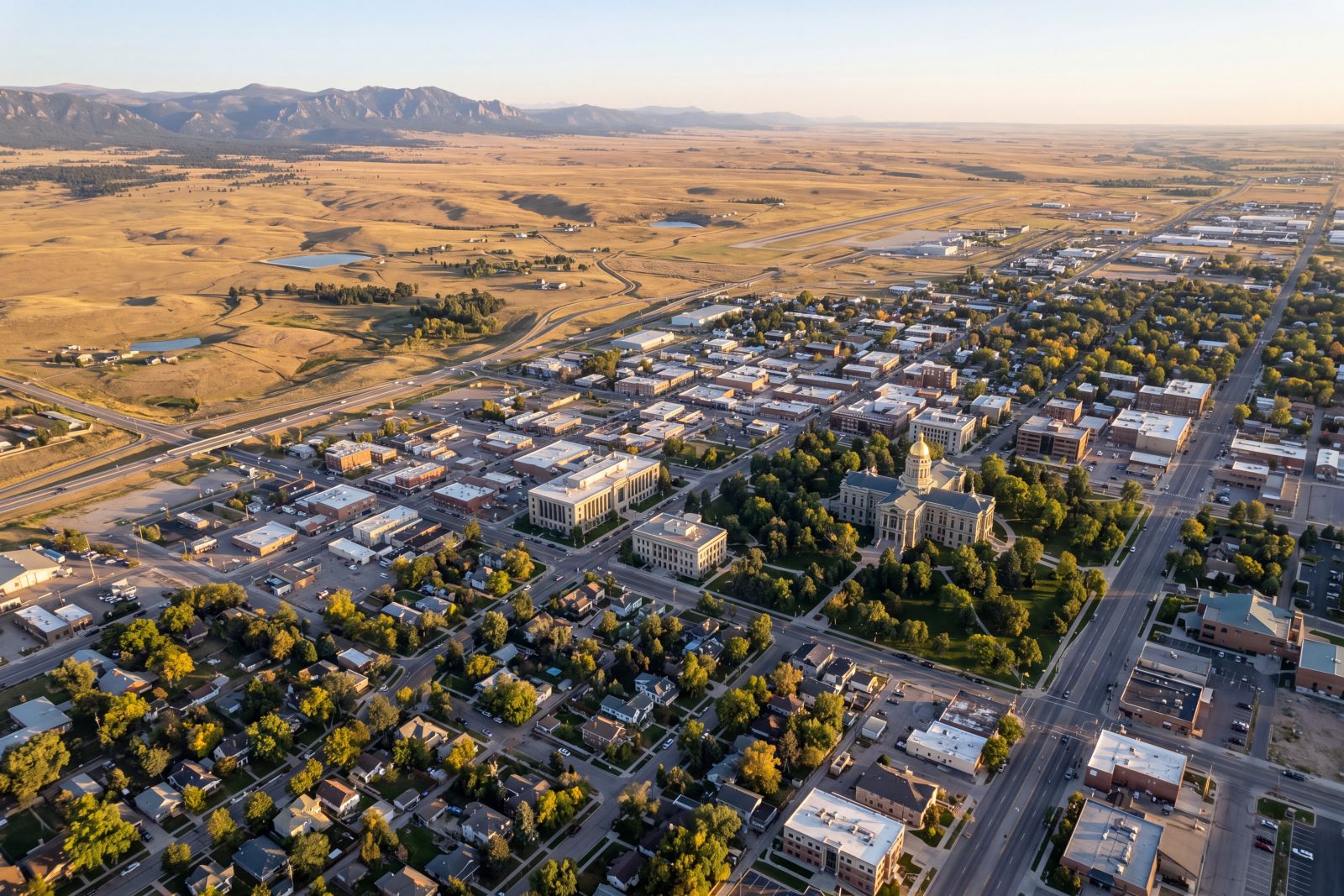
Property Tax Rate in Wyoming 2025
Effective rate, median annual bill, homestead exemption, and assessment cap rules under Wyo. Stat. Ann. § 39-13-109
Statutory authority: Wyo. Stat. Ann. § 39-13-109
What the median Wyoming homeowner pays
Median bill is the actual ACS 2022 figure for owner-occupied housing units in Wyoming. Your specific bill will vary by county and municipality, local mill rates can swing the effective rate by 30%+ within a single state.
Wyoming is one of the least expensive states in the country to hold rental real estate, and property tax is a big reason why. Residential property, whether it is your home or a rental you lease out, is assessed at 9.5% of fair market value, and the statewide average effective rate lands near 0.55% of market value, well under the roughly 1.1% U.S. average. The catch for landlords is that the state's most valuable relief programs are written for people who live in the home, not for people who rent it out. Two recent laws, the 25% homeowner exemption and the 4% annual cap, reshaped the math for owner-occupants while leaving investors on the standard footing.
How Wyoming assesses and taxes rental property
Wyoming does not tax market value directly. It taxes an assessed value, and residential property, including rentals, sits in the class assessed at 9.5% of fair market value. Industrial property is assessed at 11.5% and mineral production at 100% of value, but a single-family rental or a small apartment building falls in the 9.5% residential class.
Once the assessor sets your assessed value, the county applies a mill levy. A mill is $1 of tax for every $1,000 of assessed value. The formula is: market value multiplied by 9.5%, then multiplied by the local mill levy. On a $100,000 property at a 76-mill (.076) levy, that works out to $722 a year ($100,000 x 9.5% x .076). Mill levies vary by county, school district and municipality, so the same house can carry different bills across county lines, but the 9.5% assessment ratio is uniform statewide.
The effective rate and what it means for returns
The combination of a 9.5% assessment ratio and moderate mill levies produces one of the lowest effective property-tax burdens in the country, estimated at roughly 0.55% of market value on residential property. For a landlord, that is a meaningful operating-cost advantage: a $300,000 rental carries something in the neighborhood of $1,600 to $1,700 in annual property tax at typical levies, versus more than $3,000 in a state at the 1.1% national average.
That low carrying cost feeds straight into net operating income and cap-rate math. Property tax is usually the single largest fixed expense a Wyoming rental owner pays after debt service, so a rate near half the national norm widens margins on rent that would be marginal elsewhere. Wyoming also has no state personal or corporate income tax, so rental income is not taxed at the state level, another structural plus for out-of-state investors comparing markets.
The owner-occupancy gap: why landlords miss the 25% exemption
This is the line that matters most for investors. In 2025 the Legislature passed SF0069, creating a 25% homeowner property tax exemption on the first $1 million of fair market value. It is the largest broad-based relief on the books, and rental owners cannot use it. To qualify, the owner must occupy the property as a primary residence for at least eight months of the year. As the state's own guidance puts it, the reduction applies only to owner-occupied, single-family residential property.
The practical result is a split market. A homeowner and a landlord can own identical houses on the same street, assessed at the same 9.5% ratio, and the homeowner pays roughly a quarter less in tax on the first $1 million of value. The exemption is claimed by filing an affidavit with the county assessor, with a March 1 deadline, and it cannot be stacked with the separate long-term homeowner exemption. For a landlord, none of this applies; a leased single-family home is taxed on its full assessed value.
The 4% cap and how it treats rentals
Wyoming's other major relief measure is the 4% cap enacted as HB 45 in 2024. It exempts any increase in a residential property's assessed value above 4% over the prior year, covering both the structure and the associated land. Unlike the 25% homeowner exemption, the cap is tied to the residential class rather than to occupancy, so it limits year-over-year assessment growth on residential property broadly and blunts the tax shock that comes from a hot market re-rating values quickly.
For a landlord in an appreciating Wyoming market, that predictability is useful for underwriting: your assessed value, and therefore your tax base, cannot jump more than 4% in a single year even if comparable sales spike. It does not lower your bill the way the 25% exemption lowers a homeowner's, but it caps the speed at which the bill can grow.
What Wyoming landlords should actually do
Confirm your property is classified as residential (9.5%), not miscategorized into a higher class, and check the specific mill levy for the county and district your rental sits in, because that number, not the assessment ratio, drives the variation in your bill. Do not budget for the 25% homeowner exemption on a rental; it is off the table unless you convert the property to your own primary residence and meet the eight-month occupancy test. If you own a mixed-use situation, a duplex where you live in one unit, ask the assessor how the owner-occupied portion is treated. And lean on the two structural advantages that do reach investors: the low ~0.55% effective rate and the absence of any state income tax on your rental earnings.
Homestead Exemption Detail for Wyoming
Property Tax Refund Program for elderly and low-income; 2024 HB 0045 enacted 4% cap on annual residential assessment growth.
The exemption is granted under Wyo. Stat. Ann. § 39-13-109. To claim it, owner-occupants must typically file an application with the county assessor (most states require filing once, with renewal triggered only by change of ownership or use). Failure to file the application means full taxation at the non-homestead rate.
How Wyoming Compares Nationally
- U.S. national median effective rate: ~1.02% (Tax Foundation 2024).
- Highest effective rate state: New Jersey (2.23%).
- Lowest effective rate state: Hawaii (0.32%).
- Wyoming rank: Effective rate of 0.55%, see the full ranking table.
Sources & Methodology
- Effective rate: Tax Foundation, "Property Taxes Paid as a Percentage of Owner-Occupied Housing Value," 2024 publication using U.S. Census Bureau American Community Survey 2022 5-year estimates (Tables B25103 and B25077).
- Median bill: U.S. Census Bureau ACS 2022 5-year, Table B25103 (Median Real Estate Taxes Paid for Owner-Occupied Housing Units).
- Homestead exemption and assessment cap: Wyo. Stat. Ann. § 39-13-109 and Wyoming Department of Revenue / Assessor publications.
Related Guides for Wyoming Landlords
Figures on this page are drawn from Wyoming statute and official sources: the 9.5% residential level of assessment and mill-levy mechanics from county assessor guidance (Carbon County, WY) under W.S. 39-11-105; the 25% homeowner exemption and its owner-occupancy requirement from Wyoming Legislature bill SF0069 (2025) and the Wyoming Department of Revenue's county-assessor guidance; the 4% assessment-growth cap from HB 45 (2024); and effective-rate comparisons from published state tax datasets. Mill levies are set locally and change annually, so verify your county's current levy with the assessor before relying on any dollar estimate. This page is general information, not tax or legal advice.
Frequently Asked Questions
What is the property tax rate on a rental property in Wyoming?
Wyoming assesses residential property, including rentals, at 9.5% of fair market value, then applies a local mill levy (1 mill = $1 per $1,000 of assessed value). The statewide average effective rate is roughly 0.55% of market value, among the lowest in the country.
Can a landlord claim Wyoming's 25% homeowner exemption?
No. The 25% exemption created by SF0069 (2025) applies only to owner-occupied, single-family primary residences and requires the owner to live in the home at least eight months of the year. Rental and investment property is excluded, so a leased home is taxed on its full assessed value.
How is Wyoming property tax calculated?
Multiply the property's fair market value by the 9.5% residential assessment ratio to get assessed value, then multiply by the local mill levy. For example, a $100,000 property at a 76-mill (.076) levy owes $100,000 x 9.5% x .076 = $722 per year.
Does the 4% property tax cap apply to rentals?
The 4% cap (HB 45, 2024) limits year-over-year increases in a residential property's assessed value to 4%. It is tied to the residential class rather than to owner-occupancy, so it applies to residential rentals as well, capping how fast the assessed value, and therefore the tax base, can grow.
How does Wyoming's rate compare to the national average?
Wyoming's average effective property tax rate is estimated near 0.55% of market value, roughly half the approximate 1.1% U.S. average. Combined with no state income tax on rental earnings, this makes Wyoming a low-carrying-cost state for landlords.
Is rental income taxed by the state of Wyoming?
No. Wyoming levies no state personal or corporate income tax, so rental income is not taxed at the state level. Property tax and, where applicable, federal income tax remain the main tax considerations for rental owners.
Effective rate source: Tax Foundation analysis of Census ACS 2022 (published 2024). Statutory citation: Wyo. Stat. Ann. § 39-13-109. Last updated November 21, 2026. For informational purposes only, not tax or legal advice. Consult a CPA or tax attorney for your specific situation.