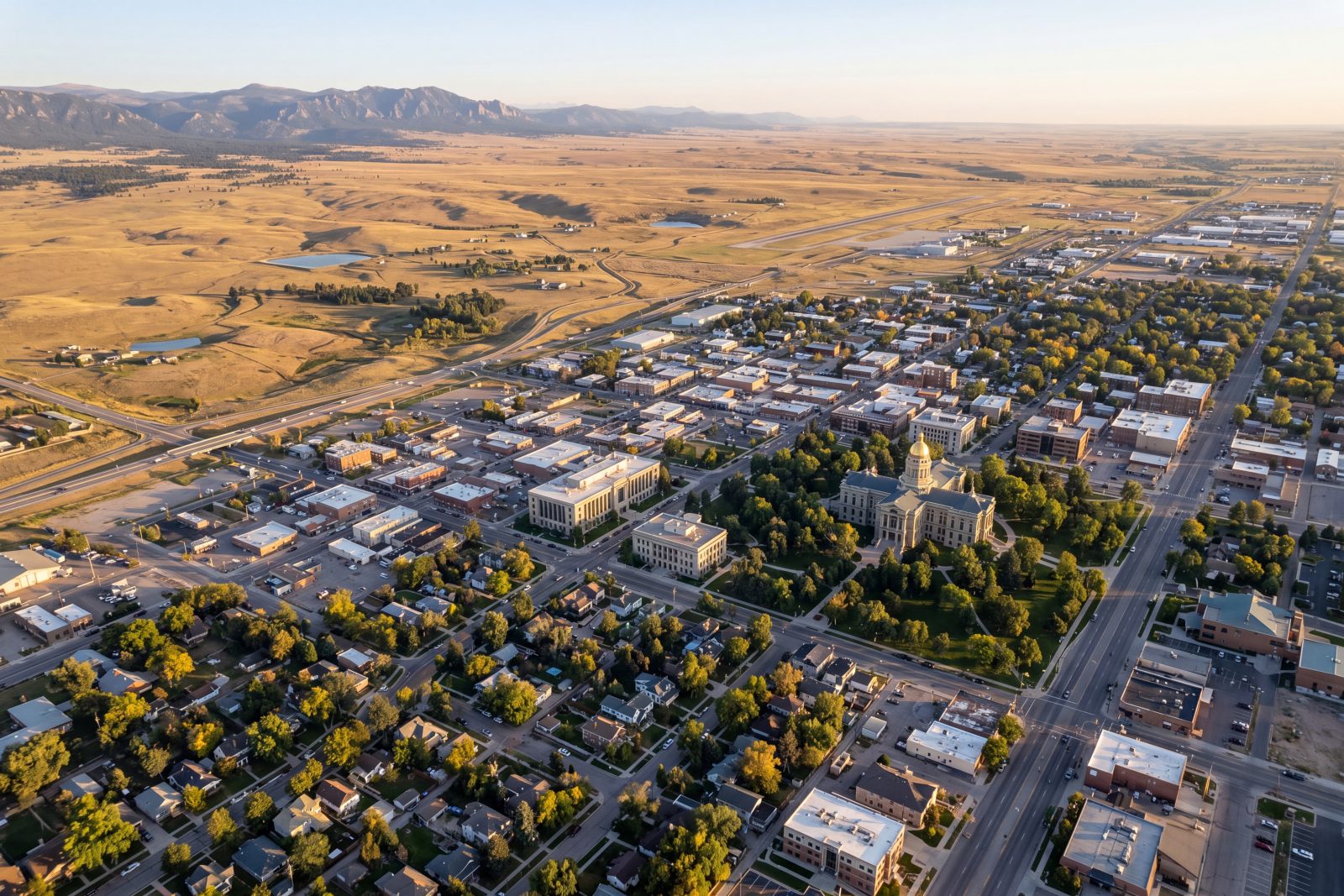
3 incorporated cities and unincorporated areas. The county Eviction Risk Score is held aloft by the city of Worland (3.9) and a small number of dense urban cores. Rent-control coverage varies by city.
In 2026
Risk score
3.2
LOW
Ranked #19 of 23 WY counties
5k residents · 3 cities · 3 tracts
1976–2026 · pop-weighted from cities
Washakie County eviction risk score history
Min1.7Average2.7Now3.2
197619861996200620162026
Key metrics
Tenant beats landlord
11.6%
/ 100 outcomes
In court-decided eviction outcomes for Washakie County, WY, tenants prevail in roughly 11.6% of contested cases. A higher number means landlords face stronger tenant defenses and longer calendars.
Timeline
22d
filing → judgment
From the moment an unlawful-detainer notice is filed in Washakie County, WY until a money judgment is entered, a contested eviction takes about 22 days on average. Longer timelines mean more lost rent for landlords.
Cost range
$0.8–2.3k
legal + lost rent
A typical eviction in Washakie County, WY costs landlords $771 to $2,338 all-in, covering court filing fees, process-server costs, attorney time, and lost rent.
Average rent
$705
31% stretched on rent
Average gross rent in Washakie County, WY is $705 per month per the U.S. Census American Community Survey. 31% of renter households here spend more than 30% of pre-tax income on rent.
Renters
30.0%
of households
30.0% of occupied housing units in Washakie County, WY are renter-occupied. A higher renter share usually correlates with more eviction filings and a more active rental market.
Poverty
11.3%
2.3% unemp.
11.3% of Washakie County, WY residents live below the federal poverty line, and unemployment runs at 2.3%. Both feed the economic-stress sub-score in our Eviction Risk Score model.
Time machine
Scrub 50 years
197619861996200620162026
2026
● LIVE · today◀ REPLAY · historical
Washakie County's 3.2/10 score reflects Wyoming's landlord-favorable statute and a small, stable rental market centered on Worland. Scores within the county range from 3.2 to 3.9/10 across its three tracked communities. Ranked 19th of 23 Wyoming counties; 18 counties carry higher risk.
How Washakie County ranks in Wyoming
Lower number means more extreme, where #1 is the most
Eviction Risk Score
Very Low
#19of 23 WY counties3.2 / 10
#19 of 23 counties in Wyoming for landlord eviction risk.
Cost of living
Low
#36of 51 states (statewide)92.7 index
Wyoming ranks #36 of 51 states on overall cost of living (7.3% cheaper than the U.S. avg).
Housing services cost
Low
#41of 51 states (statewide)71.1 index
Wyoming ranks #41 of 51 states on housing services (28.9% cheaper than the U.S. avg).
Income spent on rent
Moderate
#11of 23 WY counties27.7% of income
#11 of 23 counties in Wyoming on % of income spent on rent.
Washakie County, Wyoming eviction laws receives an eviction risk score of 3.2/10 (Low), placing it 19th out of 23 counties statewide. Of Wyoming's 23 counties, 18 carry a higher risk rating than Washakie, and 4 rank lower - positioning the county firmly in the lower-risk of the state distribution. The score range across Washakie's three tracked communities runs from 3.2 to 3.9/10, a notably tight band that reflects the county's consistent regulatory environment under Wyoming eviction laws's landlord-friendly statutory framework.
The county seat of Worland is by far the largest community here, home to roughly 4,794 of the county's 5,080 residents and carrying a score of 3.2/10. Ten Sleep, a small ranching and recreation community along the eastern slope of the Bighorn Mountains, scores 3.9/10 with a population of 239. Hyattville, the county's smallest tracked place at just 47 residents near the Bighorn Canyon, comes in at 3.2/10 - the lowest in the county and a reflection of extremely limited rental market activity. Because Worland eviction risk dominates the county's rental housing stock, its score is effectively synonymous with the county average, and landlords evaluating Washakie County should focus their analysis there first.
The underlying rental market numbers add important texture. Average gross rent sits at $705 per month, well below Wyoming eviction laws's urban centers like Cheyenne eviction risk or Jackson eviction risk, and the rent burden rate of 31.2% - the share of renter households spending more than 30% of income on housing costs - signals that while rents are low in absolute terms, some households are still stretched relative to local incomes. The renter share of occupied housing units is 30%, meaning roughly one in three households here rents rather than owns, a moderate share for a small agricultural county. The poverty rate of 11.3% adds context: a meaningful segment of the renter population may have limited financial cushion in the event of a dispute or non-payment situation, which bears on the practical risk profile even in a low-regulatory environment.
Washakie County operates under Wyoming eviction laws's uniform landlord-tenant statute (Wyo. Stat. § 1-21-1201 et seq.), which offers landlords a direct and time-predictable eviction pathway: a 3-day notice for non-payment or lease violations, 30-day notice for end-of-term situations, court filing fees between $85 and $175, and an uncontested timeline of roughly 21 to 45 days. Wyoming eviction laws does not require just cause for eviction and expressly preempts any local rent control, so Worland eviction risk and every other community in Washakie County cannot impose restrictions beyond what state law allows. There is no source-of-income protection in Wyoming eviction laws, meaning landlords retain full discretion in tenant screening criteria within federal fair housing limits. These statutory conditions are the primary driver of the county's Low risk classification.
This county profile was prepared by the Eviction Risk Map research team based on two decades of landlord-tenant law tracking, Census housing data, and court record analysis. Score calculations follow the methodology described on our methodology page. Legal data for Wyoming was last reviewed May 29, 2026.
Historical eviction filings in Washakie County
From 2014 to 2017, eviction filings in Washakie County increased.
The peak was 9 filings in 2014.1
92014
9Peak (2014)
92017
Annual filings 2014–2017No filing data published after 2018
Data covers 2000–2018, the full span of the Princeton Eviction Lab's national county court-records dataset.
How Washakie County compares
Washakie County's 3.2/10 score places it in the lower-risk of Wyoming's 23 counties. Several nearby rural counties - Johnson County, Big Horn County, and Hot Springs County - cluster in a similar range, all reflecting Wyoming eviction laws's uniformly landlord-favorable statutory environment. Sublette County and Platte County rank slightly lower in risk than Washakie. The county's score runs modestly higher than the Wyoming state average of 3.4/10, though the gap is narrow. Relative to national benchmarks, Washakie County's Low designation marks it as substantially less encumbered by tenant-protective regulation than urban coastal markets, or even mid-size metros in states like Colorado eviction laws or Montana eviction laws.
Peer counties in Wyoming
Same state, closest by population and Eviction Risk Score
Washakie County currently scores 3.2/10, classified as Low risk. It ranks 19th out of 23 Wyoming eviction laws counties, meaning 18 counties in Wyoming eviction laws carry a higher eviction risk than Washakie.
Q2
How does Washakie County compare to the Wyoming state average?
Washakie County's score of 3.2/10 sits close to the Wyoming state average of 3.4/10. The county lands in the lower-risk of Wyoming's county rankings, reflecting regulatory conditions typical of Wyoming's rural interior rather than the higher-activity markets near Cheyenne or Jackson.
Q3
What is the eviction process timeline in Washakie County?
Under Wyo. Stat. § 1-21-1201 et seq., a landlord in Washakie County must serve a 3-day notice for non-payment of rent or a lease violation, or a 30-day notice for end of term. After a case is filed, uncontested proceedings typically resolve in 21 to 45 days; contested cases can run 45 to 100 days. Court filing fees range from $85 to $175, with sheriff lockout fees between $40 and $150.
Q4
Does Worland have any local tenant protections beyond Wyoming state law?
No. Wyoming eviction laws's preemption statute bars local governments from enacting rent control or rent stabilization ordinances, so Worland eviction risk cannot layer additional protections on top of state law. Washakie County has no source-of-income protection, no just-cause eviction requirement, and no local rent cap. The state framework is the ceiling and the floor.
Q5
What is the average rent in Washakie County?
Average gross rent in Washakie County is approximately $705 per month, reflecting its rural agricultural character. About 31.2% of renter households spend more than 30% of income on rent - a moderate rent burden by Wyoming eviction laws standards but meaningful given local wage levels.
Q6
Which cities in Washakie County have the highest eviction risk?
Worland and Ten Sleep share the county's highest scores at 3.2/10 and 3.9/10 respectively. Hyattville scores 3.2/10, the lowest in the county. All three communities are classified as Low risk under the current model.